|
|
|
|
|
|
|
|

|
Don't Miss Any Special Deals - Sign Up To Our Newsletter!
| |||||||||||||||
| CLICK HERE FOR A FULL LIST OF ALL NICOLAS TRUDGIAN PRINTS BY TITLE |
|
| THIS ITEM IS INCLUDED IN OUR BUY ONE GET ONE HALF PRICE OFFER ! Choose any two prints in this special offer and the lower priced item is half price. (Any free bonus prints already supplied with an item are separate and will also be included !) Hundreds of items across our websites are included in this offer! |
| |||||||||||||||||||||||||||||
| |||||||||||||||||||||||||||||||||||||||||||||||||||||||||||||||||||
| Signatures on this item | |
| *The value given for each signature has been calculated by us based on the historical significance and rarity of the signature. Values of many pilot signatures have risen in recent years and will likely continue to rise as they become more and more rare. | |
| Name | Info |
  Air Commodore Peter Brothers CBE, DSO, DFC* (deceased) *Signature Value : £65 | Learnt to fly at the age of 16 and joined the RAF two years later in 1936. He first saw action in 1940 when as a Flight Commander in 32 Squadron, based at Biggin Hill, he flew his Hurricane against the fighters and bombers of the Luftwaffe. He recalls this as an intensely busy period, during which he shot down an Me109 - his first enemy aircraft; by the end of August that same year his tally of enemy aircraft shot down increased to eight. Awarded the DFC, he was transferred to 257 Squadron where he joined Bob-Stanford Tuck as a Flight Commander. Promoted in 1941 to Squadron Leader, Pete Brothers then took command of 457 Squadron RAAF, equipped with Spitfires. A year later when 457 Squadron returned to Australia, Pete took command of 602 Squadron. In the early autumn of 1942 he went on to become Wing Leader of the Tangmere Wing, succeeding his old friend, Douglas Bader. By the end of the war Pete Brothers had amassed 875 operational hours over a 44-month period. He was credited with having personally shot down 16 enemy aircraft and damaged many more. He later went on to command 57 Squadron during the Malaya campaign. Upon return to the UK Pete Brothers joined the V-Force, flying Valiant-4 jet bombers. He retired in 1973. Sadly, Pete Brothers died 18th December 2008. |
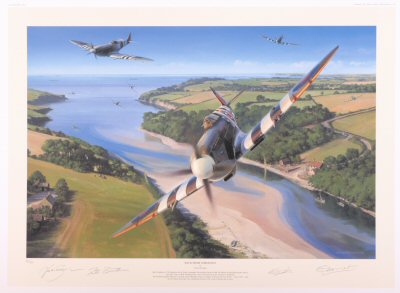
  Lieutenant General Avi Baron Mike Donnet CVO DFC FRAeS (deceased) *Signature Value : £45 | One of Belgiums most distinguished fighter pilots, Mike Donnet led 350 (Belgian) Squadron Spitfires over the D-Day beaches just before dawn, as the invasion was going in. He returned to the beachhead during the day and then finally at sunset. In all he flew 30 sorties over the beaches during the Normandy campaign. Originally a member of the Belgian Air Force, Donnet was captured by the Germans in May 1940 but subsequently made a daring escape to England by air in July 1941. Flying with 69 Squadron he scored three victories before taking command of 350 Squadron. After Normandy Donnet was in action against the V1s and the retreating German ground forces, as well as providing air cover for the Arnhem operation. In October 1944 he took command of the Hawkinge Wing of Spitfires. He rose to high command in the postwar Belgian Air Force. Mike Donnett died on 31st July 2013. |
  Squadron Leader Arthur Leigh DFC, DFM (deceased) *Signature Value : £50 | Another RAFVR pilot, The son of a regular soldier, Arthur Leigh was called up at the outbreak of war. After finishing his flying training he was posted to 7 OTU and then on to convert to Spitfires in August 1940. Arthur Leigh flew with 64 Squadron at Leconfield and 72 Squadron at Biggin Hill during the Battle of Britain before transferring to 611 Squadron. Awarded the DFM in September 1941, Leigh had then completed 50 sweeps, had destroyed two Bf 109s, probably destroyed another four and shared in the destruction of a Do 17. After a spell instructing and ferrying Hurricanes from Gibraltar to Cairo, he returned to operations with 56 Squadron flying Typhoons from Manston. He was shot down on his first sweep by flak, near Calais but was picked up by an ASR launch. In late 1943 Leigh was posted to 129 Squadron at Hornchurch and was awarded the DDC on completing his second tour in December 1944, spending the rest of the war as an instructor. He died on 3rd July 2004. |
| The Aircraft : | |
| Name | Info |
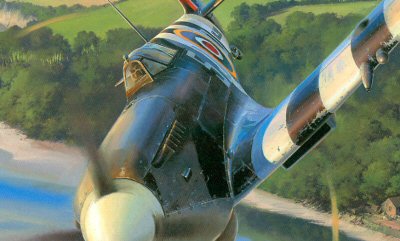
| Spitfire | Royal Air Force fighter aircraft, maximum speed for mark I Supermarine Spitfire, 362mph up to The Seafire 47 with a top speed of 452mph. maximum ceiling for Mk I 34,000feet up to 44,500 for the mark XIV. Maximum range for MK I 575 miles . up to 1475 miles for the Seafire 47. Armament for the various Marks of Spitfire. for MK I, and II . eight fixed .303 browning Machine guns, for MKs V-IX and XVI two 20mm Hispano cannons and four .303 browning machine guns. and on later Marks, six to eight Rockets under the wings or a maximum bomb load of 1,000 lbs. Designed by R J Mitchell, The proto type Spitfire first flew on the 5th March 1936. and entered service with the Royal Air Force in August 1938, with 19 squadron based and RAF Duxford. by the outbreak of World war two, there were twelve squadrons with a total of 187 spitfires, with another 83 in store. Between 1939 and 1945, a large variety of modifications and developments produced a variety of MK,s from I to XVI. The mark II came into service in late 1940, and in March 1941, the Mk,V came into service. To counter the Improvements in fighters of the Luftwaffe especially the FW190, the MK,XII was introduced with its Griffin engine. The Fleet Air Arm used the Mk,I and II and were named Seafires. By the end of production in 1948 a total of 20,351 spitfires had been made and 2408 Seafires. The most produced variant was the Spitfire Mark V, with a total of 6479 spitfires produced. The Royal Air Force kept Spitfires in front line use until April 1954. |
|
Contact Details |
|
Sign Up To Our Newsletter!
This website is owned by Cranston Fine Arts. Torwood House, Torwoodhill Road, Rhu, Helensburgh, Scotland, G848LE Contact: Tel: (+44) (0) 1436 820269. Email: cranstonorders -at- outlook.com |
 |


 Buy 1 Get 1 Half Price!
 Brothers, Peter

 Brothers, Peter