Order Enquiries (UK) : 01436 820269

You currently have no items in your basket


Buy with confidence and security!
Publishing historical art since 1985

Don't Miss Any Special Deals - Sign Up To Our Newsletter!
Aircraft
Search
Signature
Search
Squadron
Search
Tank
Search
SEE THIS MONTH'S SPECIAL OFFERS
Product Search         
CLICK HERE FOR A FULL LIST OF ALL NICOLAS TRUDGIAN PRINTS BY TITLE
ALWAYS GREAT OFFERS :
20% FURTHER PRICE REDUCTIONS ON HUNDREDS OF LIMITED EDITION ART PRINTS
BUY ONE GET ONE HALF PRICE ON THOUSANDS OF PAINTINGS AND PRINTS
FOR MORE OFFERS SIGN UP TO OUR FREE NEWSLETTER

Ace with 13.50 Victories

Wing Commander John Freeborn DFC*

Wing Commnader John. C. Freeborn was born on the 1st of December 1919 in Middleton, Yorkshire. John left grammar school at 16 and joined the RAF in 1938, where he made 14 shillings a week and shot pheasant in his spare time. He later visited his classmates after flight school by landing his plane on a nearby cricket pitch. In March 1938 John Freeborn was commissioned in the RAFO, and on the 9th of April 1938 went to Montrose and joined 8 FTS, where he completed his training before going to 74 'Tiger' Squadron at Hornchurch on 29th October. He relinquished his RAFO commission on being granted a short service one in the RAF in January 1939. Johnie Freeborn flew Spitfires with 74 Squadron over Dunkirk, and claimed a probable Ju 88 on May 21st 1940. On the 22nd of May 1940 he destroyed a Junkers 88, and a probable Bf 109 on the 24th of May followed soon after on the 27th by a Bf 109 destroyed and another probably destroyed. On one occasion his Spitfire was badly damaged over Dunkirk and he crash-landed on the beach near Calais but managed to get a lift home in a returning aircraft. His squadron flew relentlessly during the Battle of Britain. In one eight-hour period, its pilots flew into combat four times, destroying 23 enemy aircraft (three by John Freeborn) and damaging 14 more. Five kills denoted an Ace and by the end of the Battle of Britain, John had seven to his credit and won the DFC. John claimed a Bf 109 destroyed on 10th July, shared a probable Dornier 17 on the 24th, shot down a Bf 109 on the 28th, destroyed two Bf 110s, a Bf 109 and probably another on 11th August, destroyed a Do 17 on the 13th, destroyed another on 11th September and damaged an He 111 on the 14th. Freeborn was made a Flight Commander on 28th August. He shared a Bf 109 on 17th November, shot down two Bf 109s, shared another and damaged a fourth on 5th December, and damaged a Dornier 17 on 5th February and 4th March 1941. John Freeborn had been with his squadron longer, and flown more hours, than any other Battle of Britain pilot and on the 25th of February 1941 John freeborn was awarded a Bar to the DFC. In January, 1942 John Freeborn was posted to Army Air Force Base in Selma, Alababma which was home to the South East Training Command in America. After two months as RAF liaison officer he went to Eglin Field, Florida where he helped in testing various aircraft, including the new fighters the Thunderbolt and P-51 Mustang. He returned to the UK in December 1942 and went to Harrowbear, Exeter, and then to Bolt Head as Station Commander. John Freeborn joined 602 Squadron in 1942, and commanded 118 Squadron in June 1943 at Coltishall, leading it until January 1944. In June 1944 he was promoted Wing Commander (the youngest Wing Commander in the RAF) of 286 Wing in Italy. John Freeborn scored 17 victories and left the Royal Air Force in 1946. Sadly, we have learned that John Freeborn passed away on 28th August 2010. John Freeborn was truly one of the great Fighter Pilots of world war two and his autograph is certainly a major additon to any signature collection, as he did not sign a great deal of art pieces.


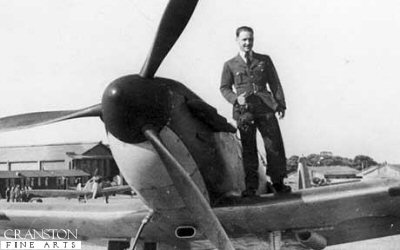
John Freeborn standing on his aircraft

John Freeborn with Bob Yeoman.

John Freeborn with Cranston Fine Arts owner David Higgins.

Cranston Fine Arts would like to thank Bob Yeoman for his help in carrying out this signing session with John Freeborn, and of course John Freeborn himself for taking the day (28/2/2010) to sign our art prints.


Awarded the Distinguished Flying CrossAwarded a Bar to the Distinguished Flying Cross
Distinguished
Flying Cross
Bar to the
Distinguished
Flying Cross

Wing Commander John Freeborn DFC* - Signed Nicolas Trudgian Aviation Art Prints
Pilot and Aircrew Signatures

First Flap of the Day by Nicolas Trudgian.


First Flap of the Day by Nicolas Trudgian.
7 editions.
6 of the 7 editions feature up to 4 additional signatures.
£105.00 - £200.00

Readiness At Dawn - The Battle of Britain, 1940 by Nicolas Trudgian


Readiness At Dawn - The Battle of Britain, 1940 by Nicolas Trudgian
One edition.
The edition features an additional signature.
£35.00


<3>
Text for the above items :

First Flap of the Day by Nicolas Trudgian.

HM Stephen - one of the Battle of Britains top scoring fighter pilots, brings down two Me109s in quick succession over the White Cliffs of Dover, early on August 11, 1940. Flying a Spitfire with 74 Squadron, HM shot down five German aircraft on this day, and damaged a further three. The note in his log book starts First flap of the day at 0600 hrs ...

Published 2000.

Sadly, all of the pilots who signed this edition have since passed away.


Readiness At Dawn - The Battle of Britain, 1940 by Nicolas Trudgian

Spitfires of 74 Squadron return to their base from an intense dogfight over the English Channel. As soon as they land they are hastily re-armed and re-fuelled by their diligent ground crews, so at a moments notice they can be scrambled to intercept another raid from the German Luftwaffe. By the end of October 1940 The Battle of Britain was won by the gallant few and the plans to invade England were terminated.


Wing Commander John Freeborn DFC*
Squadron details


No.602 Sqn RAF
Country : UK
Disbanded 10th March 1957
Known Codes : , LO, ZT, DU,


No.602 Sqn RAF

City of Glasgow (Auxiliary)

Cave leonem cruciatum - Beware the tormented lion

We have been informed by pilot Ian Blair about one of the aircraft of this squadron : The Spitfire MkVII had the Squadron markings of 312 Sqdn (DU-G) but the aircraft was on the strength of 602 Sqn. and was inherited by 602 Sqn from the Station Flight at Skae Bray, after 312 Sqn had left the area. The time span did not permit the ground personnel sufficient time to paint new letters on the aircraft. This fact has led to the incorrect assumption that I, the pilot of the aircraft, was a member of 312 Sqn.


No.74 Sqn RAF
Country : UK
Known Codes : , GM, JH, 4D, ZP,


No.74 Sqn RAF

Trinidad

I fear no man

Hurricane of 56 Squadron was shot down by mistake by No. 74 Squadron and Pilot Officer M L Halton-Harrop of 56 sqd was killed on the 6th September 1939


Wing Commander John Freeborn DFC*
Aircraft details


Spitfire
Manufacturer : Supermarine
Built : 20351


Spitfire
Royal Air Force fighter aircraft, maximum speed for mark I Supermarine Spitfire, 362mph up to The Seafire 47 with a top speed of 452mph. maximum ceiling for Mk I 34,000feet up to 44,500 for the mark XIV. Maximum range for MK I 575 miles . up to 1475 miles for the Seafire 47. Armament for the various Marks of Spitfire. for MK I, and II . eight fixed .303 browning Machine guns, for MKs V-IX and XVI two 20mm Hispano cannons and four .303 browning machine guns. and on later Marks, six to eight Rockets under the wings or a maximum bomb load of 1,000 lbs. Designed by R J Mitchell, The proto type Spitfire first flew on the 5th March 1936. and entered service with the Royal Air Force in August 1938, with 19 squadron based and RAF Duxford. by the outbreak of World war two, there were twelve squadrons with a total of 187 spitfires, with another 83 in store. Between 1939 and 1945, a large variety of modifications and developments produced a variety of MK,s from I to XVI. The mark II came into service in late 1940, and in March 1941, the Mk,V came into service. To counter the Improvements in fighters of the Luftwaffe especially the FW190, the MK,XII was introduced with its Griffin engine. The Fleet Air Arm used the Mk,I and II and were named Seafires. By the end of production in 1948 a total of 20,351 spitfires had been made and 2408 Seafires. The most produced variant was the Spitfire Mark V, with a total of 6479 spitfires produced. The Royal Air Force kept Spitfires in front line use until April 1954.

Contact Details
Shipping Info
Terms and Conditions
Cookie Policy
Privacy Policy

Join us on Facebook!

Sign Up To Our Newsletter!

Stay up to date with all our latest offers, deals and events as well as new releases and exclusive subscriber content!

This website is owned by Cranston Fine Arts.  Torwood House, Torwoodhill Road, Rhu, Helensburgh, Scotland, G848LE

Contact: Tel: (+44) (0) 1436 820269.  Email: cranstonorders -at- outlook.com

Follow us on Twitter!

Return to Home Page